
Databricks and NVIDIA have open-sourced Genesis Workbench, a modular reference stack that wires GPU-accelerated biology models directly into the Databricks platform for end-to-end computational drug discovery. The stack covers genomics, single-cell analysis, large-molecule design, small-molecule docking, and model fine-tuning—each as an independently deployable module—and ships with a React-based point-and-click UI so bench scientists can run full discovery pipelines without touching code. The entire environment deploys via a single script.
The architecture solves a specific configuration tax. Life sciences teams have historically had to configure CUDA environments, build cross-discipline data pipelines from scratch, wire up governance controls for sequence and patient data, and manage ADMET scoring and docking tools that share no common substrate. Genesis Workbench replaces that plumbing with a single Databricks-native substrate: Unity Catalog handles access control and audit; MLflow tracks every model artifact; GPU Model Serving runs inference inside the customer's own workspace. At runtime, there are zero external API calls—sequences, compound libraries, and assay results never leave the governed perimeter.
The NVIDIA component maps cleanly to each discovery stage. Parabricks handles GPU-accelerated variant calling in the genomics module. RAPIDS-singlecell turns overnight clustering jobs into interactive UMAP and differential expression. Large-molecule design runs ESMFold, RFdiffusion, and ProteinMPNN for structure prediction and binder design. Small-molecule work goes through MolMIM, DiffDock, and UniMol. Fine-tuning runs via the BioNeMo Agent Toolkit on proprietary in-house datasets. Each model lives in Unity Catalog and is served from a GPU endpoint in the same workspace—adopting a newer model is a deploy step, not a rewrite.

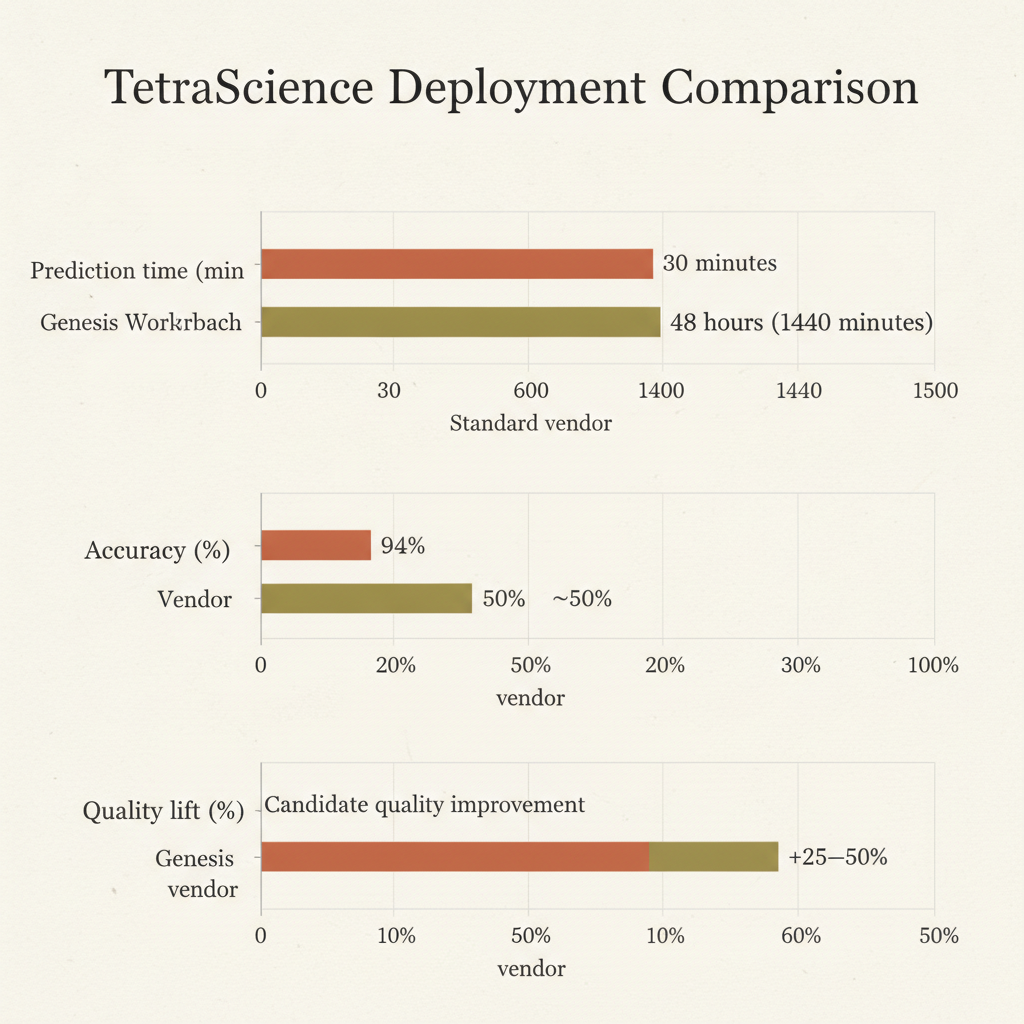
Production numbers come from TetraScience, which deployed Genesis Workbench patterns at a top-20 pharma. That deployment achieved binding predictions at 94% accuracy in 30 minutes, versus 48 hours at roughly 50% accuracy using standard vendor software. Candidate quality improved 25–50% and lead identification accelerated by up to 50%. Cell line development—normally 6–8 months—dropped to 2.5 months using NVIDIA VISTA-2D and Geneformer on BioNeMo. These outcomes are from a specific configuration at one site but establish a ceiling for what the stack can do when data governance is tight.
Genesis Workbench also ships with an MCP server that auto-deploys alongside the core. This exposes the workbench's models and workflows as callable tools for any MCP-compatible client—Databricks AI Playground, Claude, Cursor, or a custom agent. The declarative workflow canvas, called Vortex, lets users describe the science they want and get a runnable pipeline without manual wiring. Cross-discipline handoffs—genomics findings flowing into single-cell validation, then into structural prediction, docking, and ranking—happen in-app rather than through copy-paste between systems.
The architecture assumes teams already have proprietary datasets in Delta Lake and compute budget for serverless GPU inference. Teams still extracting data from instrument-specific silos or relying on vendor-hosted ADMET APIs need to solve the data-engineering problem first. The modular design lets you deploy the genomics module alone before touching small-molecule work, but the single-script install is a starting point, not a production shortcut.
Architect's takeaway: if your life sciences AI stack ships proprietary sequence or patient data to a third-party API at inference time, Genesis Workbench's Unity Catalog governance pattern—not the models themselves—is the piece worth studying first.