
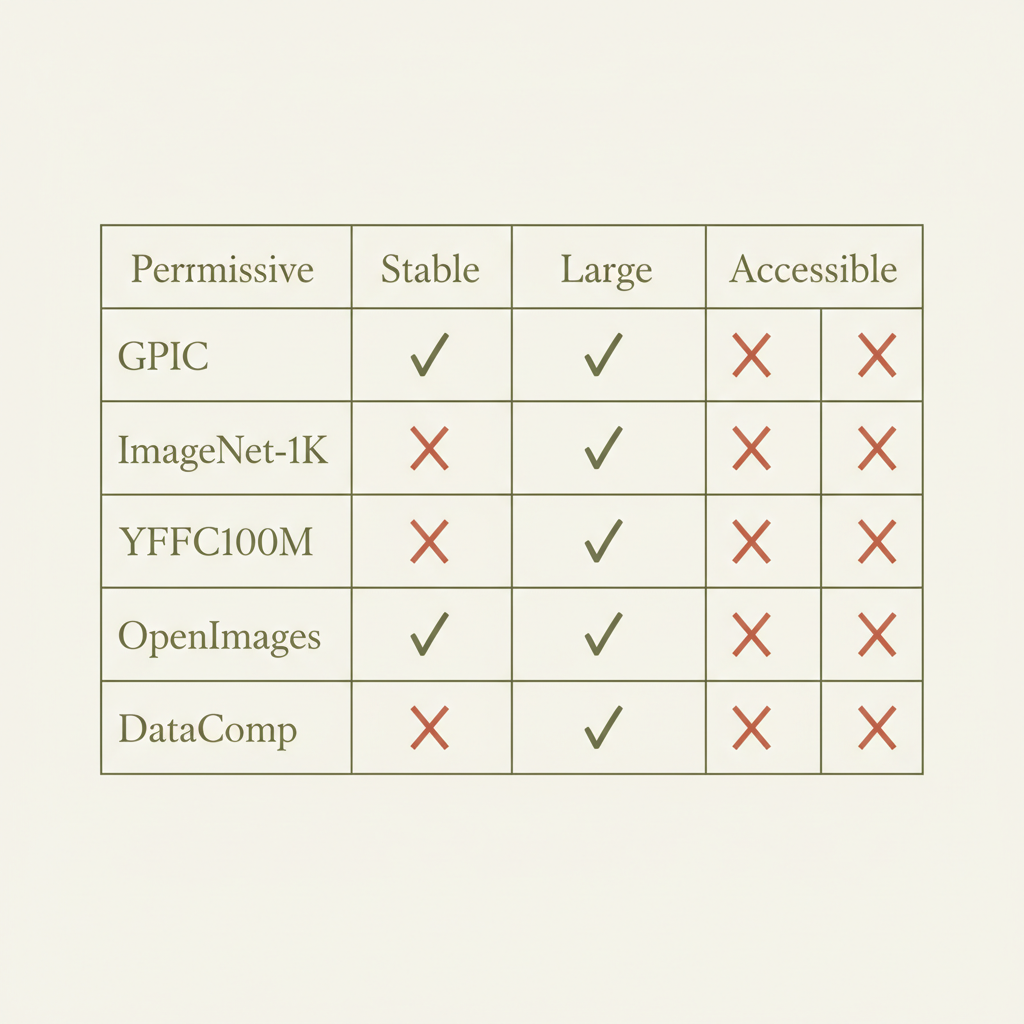
GPIC, a 27.97-trillion-pixel image corpus licensed under MIT, aims to replace ImageNet-1K as the standard for training and evaluating modern visual generative models. It includes 100 million training, 200 thousand validation, and 1 million test examples, partitioned into 8,000 shards on Hugging Face.
The corpus addresses four requirements that existing datasets fail to meet: permissive licensing, resistance to link rot, sufficient scale, and accessibility without custom crawling infrastructure. Developed by Stanford Vision Lab, University of Michigan, Radical Numerics, and Salesforce Research, the team crawled permissively licensed images, captioned them with Qwen3-VL-4B, applied safety filtering and deduplication, and froze the output into 12.9TB of static shards. The average image resolution is 479×587 pixels, and the release includes smaller subsets: GPIC-Lite (10M images) and GPIC-Nano (1M) for rapid prototyping.
The evaluation protocol replaces FID against ImageNet-1K with FD-DINOv2 computed against a held-out set of 1 million GPIC test images, as the authors consider FID to be saturated and misleading. A pixel-space flow matching baseline trained on GPIC is provided, though training details are not reported.
For ML platform teams, data movement involves 12.9TB egress from Hugging Face to the training cluster, with significant decompress-and-decode overhead due to the average image resolution of 479×587 pixels. The 8,000-shard layout aids parallelization but requires a data loader capable of managing that granularity without dropping GPU utilization below 90 percent. The paper omits the GPU-hours and cost required to caption 100 million images with Qwen3-VL-4B, as well as the hosting cost for 12.9TB of centralized storage, necessitating estimations for teams budgeting derivative pipelines.
Integration challenges include the fact that every caption was generated by Qwen3-VL-4B, which means downstream models will inherit its biases and inaccuracies. The safety filtering pipeline is described but not released, making it impossible to audit or recover removed content for certain domains. The shift from ImageNet-1K FID to FD-DINOv2 creates a benchmark discontinuity, requiring updates to model cards and comparison tables.
The takeaway is the importance of static, permissively licensed, VLM-captioned data mirrors with tiered subsets to mitigate legal and infrastructure risks.